Investigations of this Gorgonian began in 2014 when our Seasearch survey team witnessed its destruction in the entrance to the Écrehous reef by dredgers.
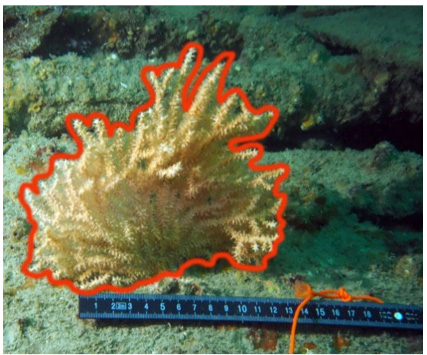
Measuring Ev size
Our photographic evidence played a major role in the creation of the large area that became protected. Dredgers have continued to argue that seabeds recover quickly but the truth is the exact opposite.
Our first visit to the Sauvage reef revealed that within this complex submerged system there was potentially the only example of a dense Ev community that represented an age range spanning an expected life span
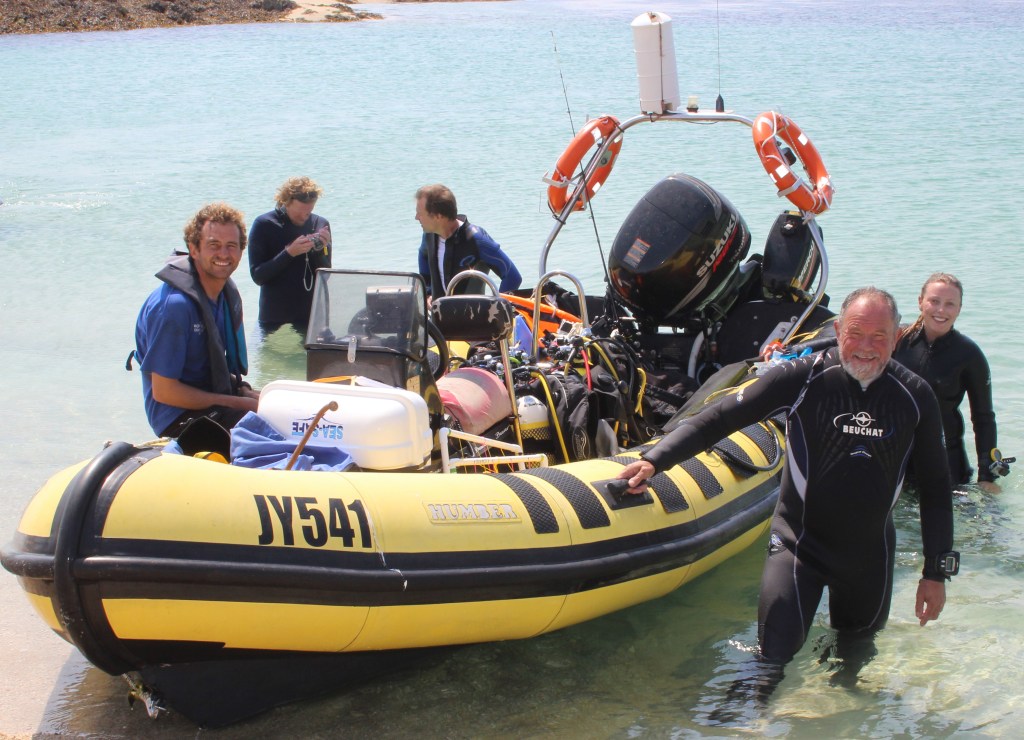
Seasearch Team Sam Blampied (Dr.) Dr Paul Chambers, Adam West, Bob Tompkins, Skipper Will Finnemore.
Photo KMcIlwee
JMC convinced the government Future Jersey study group that this soft coral, Eunicella verrucosa (Ev) EV provided a marine environment indicator that could help inform the assessment alongside terrestrial and economic indicators, demonstrating the impacts of Biodiversity decline, over fishing and climate change. Reports were compiled on the main EV communities with the Seafans being measured and the state of health examined.
With the study and proposals for marine protected areas we focused on key sites in the Pipettes, Pater Noster and Sauvage reefs.
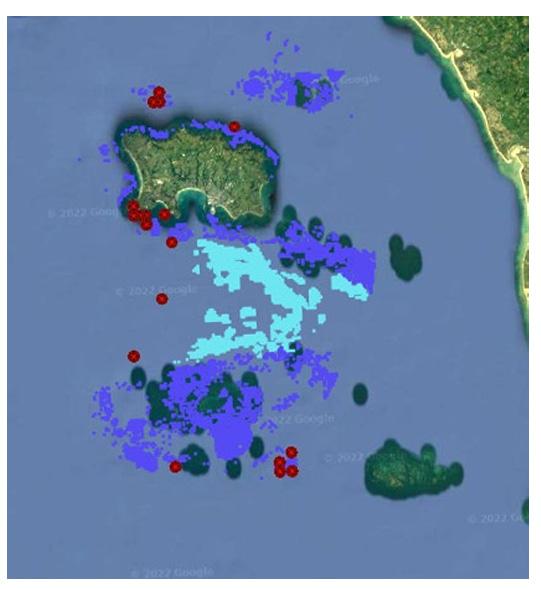
In 2019 an MSc study compared distribution and created a predictive model for where Pink Seafans are most likely to be located within our Territorial waters. The project and survey finds have provided key information in the the creation of Jersey’s Marine Spatial plan and inclusion of the species with the 2021 Jersey Wildlife Law.
The project was made possible with the help of the Association of Jersey Charities and the Channel Islands Lottery Fund. We hope this study will be ongoing however a scientific paper was published in 2022 reporting on the current findings. https://cdn.irr.enrapture.solutions/download/IRRJICAS2022.02.pdf
(Pink sea fans became a protected species in Jersey Waters in 2021 with the passing of the Wildlife Law).


